Social media is not just a marketing channel in the digital-first world today. It is a social environment where clients post reviews, experiences, and create brand perceptions in real-time. All the tweets, comments, reviews, and posts bear emotion, either negative, positive, or even neutral. This is where the social media sentiment analysis comes in.
Social media sentiment analysis uses AI to find out if online conversations about a brand are positive, negative, or neutral.
Sentiment analysis can assist business organizations in determining the mood of people towards their brand, product, service, or industry by examining the tone of emotion employed in social media discussions that concern them. Rather than reading thousands of comments manually, AI-based applications can automatically categorize the sentiment and uncover trends that would not have been realized otherwise.
Many businesses now rely on sentiment analysis to track public opinion online. Industry estimates suggest that over 80% of companies use sentiment analysis to understand customer opinions and improve decision-making.
Research from Sprout Social shows that around 70% of customer purchase decisions are influenced by emotional factors, while only 30% are based on rational thinking. This makes analyzing sentiment in online conversations essential for understanding how customers truly feel about a brand.
Let’s break it down clearly.
What Is Social Media Sentiment Analysis?
Social media sentiment analysis is the use of AI and natural language processing to identify whether online conversations about a brand are positive, negative, or neutral. Businesses use it to track public opinion, measure customer satisfaction, and detect reputation risks in real time.
It is an analysis of text information on the following platforms:
- X (Twitter)
- YouTube comments
- Online reviews and forums
For example:
- This product transformed my life! → Positive feeling.
- Customer service was poor → Negative sentiment.
- I tried it last night. → Neutral feeling.
Making use of state-of-the-art sentiment analysis tools does not just stop at classification. They are able to find the context, sarcasm, urgency, and intensity of the emotion.
How to Measure Sentiment Score?
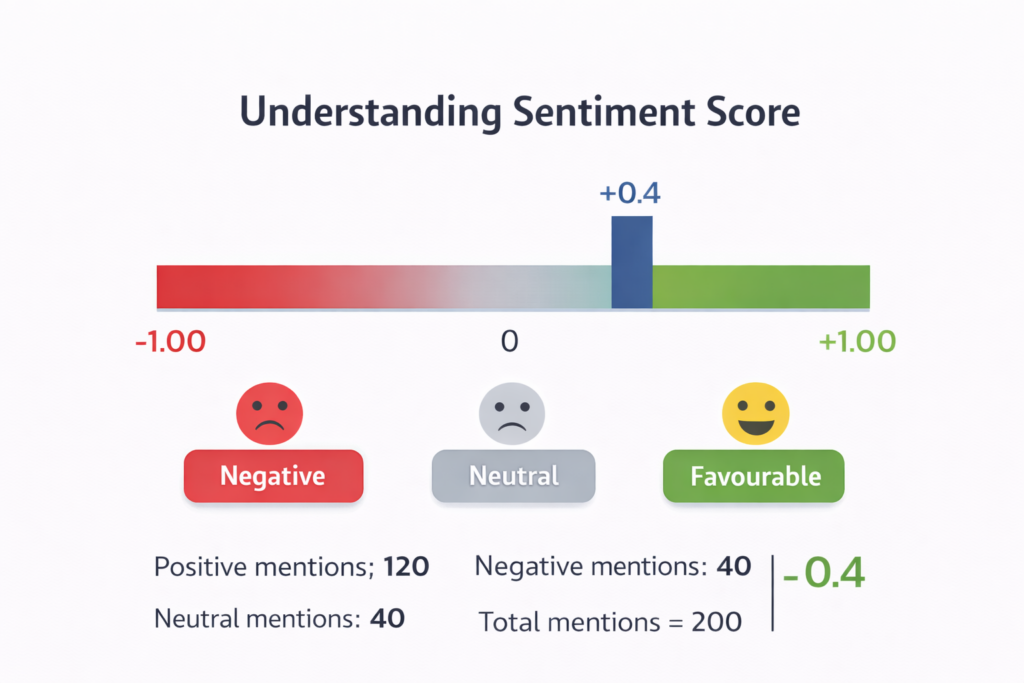
Image Source: AI-Generated
Sentiment analysis tools measure overall public opinion by calculating a sentiment score based on positive and negative mentions.
A common formula used is:
Sentiment Score = (Positive Mentions − Negative Mentions) ÷ Total Mentions
Example
- Positive mentions: 120
- Negative mentions: 40
- Neutral mentions: 40
Total mentions = 200
Sentiment Score = (120 − 40) ÷ 200 = 0.4
Score Interpretation
| Score Range | Meaning |
| -1 to -0.5 | Strong negative sentiment |
| -0.5 to 0 | Slightly negative sentiment |
| 0 | Neutral sentiment |
| 0 to +0.5 | Positive sentiment |
| +0.5 to +1 | Strong positive sentiment |
A positive score means overall sentiment toward the brand is favourable, while a negative score suggests more criticism than praise.
Sentiment Analysis and Its Usage in Social Media
Social media moves fast. One viral post can either build or ruin a brand image in a few hours. Businesses would be left to react blindly, in the absence of sentiment analysis.
Research from Gartner suggests that customer sentiment will influence more than 80% of business decisions in the coming years. This is why many organisations now rely on AI-powered tools to track how customers feel about their brand in real time.
Here’s why it matters:
Real-Time Reputation Monitoring
The negative spikes can be identified and addressed immediately by the brands before things fall out of hand.
Customer Experience Knowledge
Trends in complaints or compliments give an insight into product strengths and weaknesses.
Performance Evaluation of the Campaign
Sentiment assists in predicting the response of marketing campaigns in terms of emotion.
Competitive Intelligence
Brands are able to gauge the perception of the people with competitors.
Crisis Detection
Abnormal negative sentiment is usually an indication of new PR problems.
How Sentiment Analysis Works on Social Media?
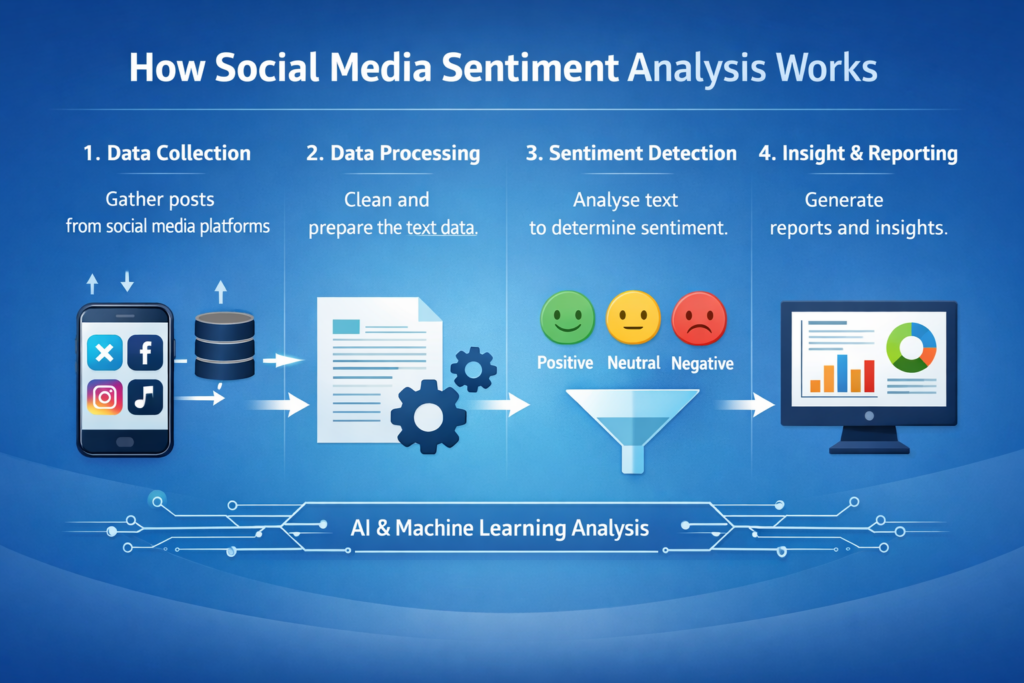
Image Source: AI-Generated
The tool of sentiment analysis usually performs the following steps:
- Data Collection – Collection of references on social media sites.
- Text Processing – Cleaning and preparing data with NLP.
- Sentiment Classification – Classifying mentions as either positive, negative, or neutral.
- Context and Emotion Detection – Determining whether intensity, sarcasm, or intent.
- Trend Analysis – Timing the sentiment.
- Reporting & Alerts – Providing an insight in the form of dashboards and notifications.
The current models of AI are trained using large data to learn slang, emojis, abbreviations, and industry-oriented language.
Example of Social Media Sentiment Analysis
In 2017, PepsiCo released a commercial featuring Kendall Jenner that quickly sparked backlash across social media platforms.
Many users felt the advertisement trivialised social justice protests. Within hours, thousands of posts appeared on platforms like X, YouTube, and Facebook criticising the campaign.
Example mentions
Positive
“Creative concept, but the message could have been clearer.”
Negative
“This ad completely misunderstands real protest movements.”
Neutral
“Pepsi just released a new ad with Kendall Jenner.”
Sentiment Analysis Results
Social media monitoring tools detected a sharp spike in negative sentiment shortly after the advertisement was released. A large number of posts criticised the tone of the campaign.
Key Insight
The surge in negative sentiment indicated a potential reputational risk. Pepsi removed the advertisement in less than 48 hours and issued a public apology.
Types of Sentiment Analysis in Social Media
Not all sentiment analysis works the same way. Here are the main types:
| Type of Sentiment Analysis | What It Does | Example |
|---|---|---|
| Basic Sentiment Classification | Labels mentions as positive, negative, or neutral | “Great service” – Positive |
| Emotion Detection | Identifies emotions like joy, anger, frustration | “I’m furious about this delay” – Anger |
| Aspect-Based Sentiment | Analyzes sentiment about specific features | “Love the design but hate the battery life” |
| Intent Analysis | Detects buying or complaint intent | “Thinking of switching brands” |
| Trend-Based Sentiment | Tracks sentiment changes over time | Weekly sentiment performance |
Aspect-based sentiment analysis is especially useful for product-driven brands because it identifies exactly what customers like or dislike.
Benefits of Using AI for Sentiment Analysis
The benefits of AI-based sentiment analysis are obvious:
- Searches through thousands of mentions in a second.
- Tracks trends that people would not have noticed.
- Provides real-time alerts.
- Enhances the rate of customer response.
- Improves the use of data to make decisions.
Brands do not rely on the guesses of how their emotions feel but instead on the quantifiable emotional insights.
Sentiment Analysis vs Social Media Monitoring
Both sentiment analysis and social media monitoring help brands understand online conversations, but they serve different purposes.
| Feature | Sentiment Analysis | Social Media Monitoring |
|---|---|---|
| Focus | Analyses the emotional tone of conversations | Tracks brand mentions, keywords, and discussions |
| Insight Provided | Reveals how people feel about a brand or product | Shows what people are saying about a brand |
| Output | Positive, negative, or neutral sentiment | Number and frequency of mentions |
| Purpose | Understand customer emotions and opinions | Monitor brand presence across platforms |
In simple terms, social media monitoring identifies conversations, while sentiment analysis helps interpret the emotions behind those conversations.
Real-World Use Cases
Social media sentiment analysis is utilized in the following sectors:
- Retail: Keep track of product feedback post-launch.
- Fintech: Monitor credibility and trust.
- Healthcare: Measure patient experience feelings.
- Technology: Find out recurring user complaints.
- Hospitality: Track the trends in guest satisfaction.
It converts haphazard online dialogues to organized knowledge.
Frequently Asked Questions (FAQs)
What is sentiment analysis in social media in simple terms?
The sentiment analysis in social media refers to the application of AI to know whether conversations about a brand online are favorable, unfriendly, or neutral.
What is the accuracy of sentiment analysis?
What is the accuracy of sentiment analysis?
The quality of the results depends on the training data and the AI model. High-accuracy advanced systems can still fail with sarcasm or context.
Can sentiment analysis detect emotions beyond positive or negative?
Yes. Emotions that can be detected with advanced tools are anger, joy, frustration, excitement, or disappointment.
Can sentiment analysis be applied to large companies only?
No. Customer sentiment can be known in real-time to benefit startups, small companies, and enterprises.
Does sentiment analysis work on emojis?
The current AI-oriented systems are able to analyze emojis as emotional indicators, enhancing the accuracy of social media analysis.
What is the role of sentiment analysis in managing a crisis?
The abrupt change in the negative sentiment may be an indicator of some emerging problems, which brands may react to in a timely manner, eliminating the reputational harm.
Final Takeaway
It is essential to know what individuals say about your brand. It is even more effective to know their feelings.
Social Media Sentiment analysis bridges that gap. By using AI and natural language processing, businesses can transform thousands of scattered social conversations into clear emotional insights. It allows brands to monitor reputation, improve customer experience, measure campaign success, and detect crises before they escalate.
Sentiment analysis is no longer an option in a world where perception changes fast. Brands that intend to remain updated, responsive, and competitive have a strategic need to do so.
Sentiment analysis is the understanding behind social media, as it is the primary means of communication.

Leave a Reply